 Wawa-news.com Local and Regional News
For thousands of years, the night sky has been a mystical place of wonder and entertainment. Those who followed the sky regularly realized the paths of brighter objects as they traversed the starry background over weeks, months and even years. The early Greeks called them planete, meaning the “wanderers”.
Of the eight main planets of the solar system, we can see Mercury, Venus, Mars, Jupiter and Saturn with the unaided eye, while Uranus and Neptune are only seen in binoculars and a telescope. Even the Sun and Moon were also referred to as the wanderers, and these seven are named as the days of the week.
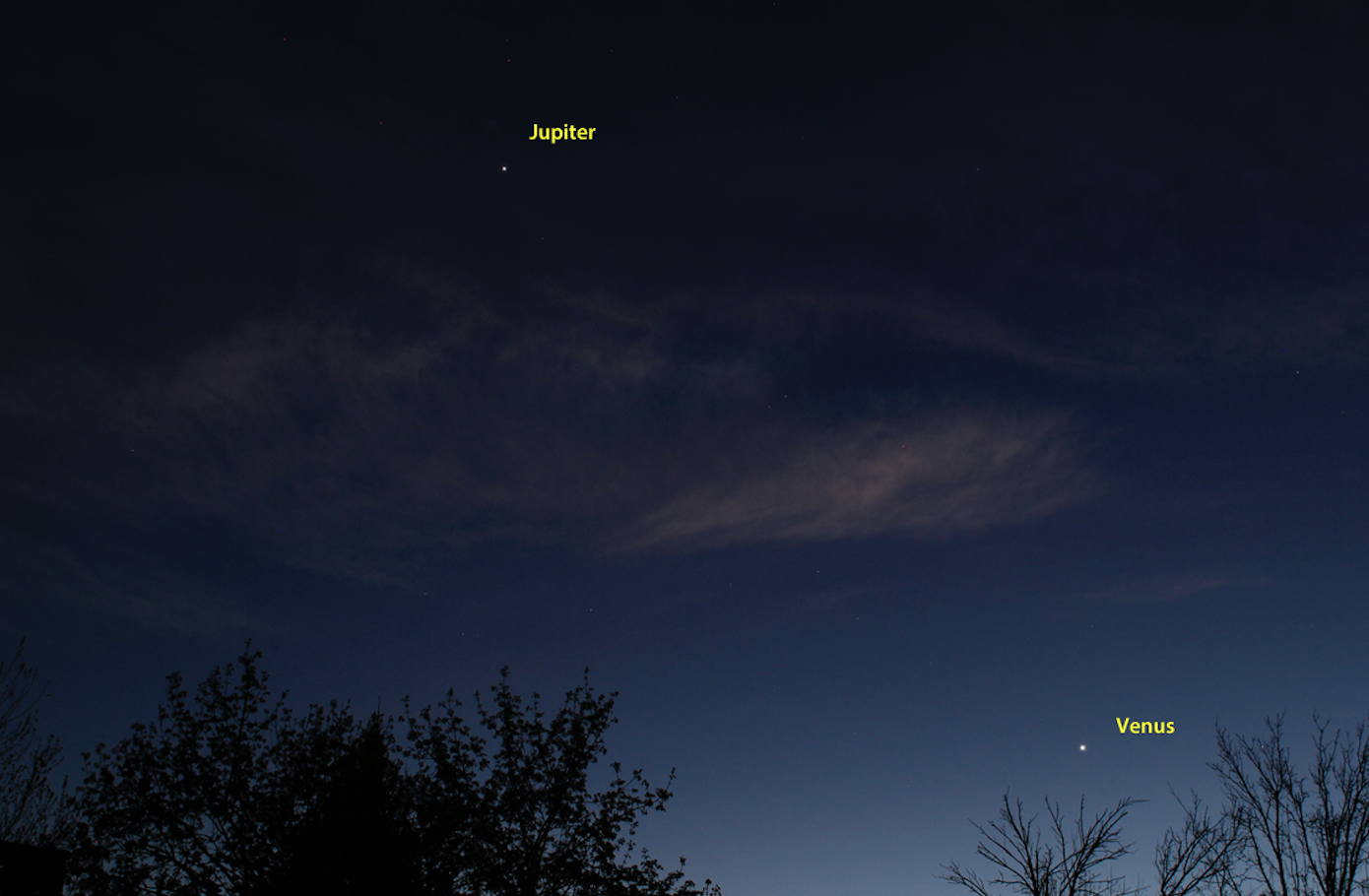
Looking towards the western sky will reward you with seeing the two brightest planets. Brilliant Venus is lower in the sky with the giant planet Jupiter to the upper left. Over the next few weeks, you will see Jupiter appearing a bit lower each night while Venus is moving up due to its orbit around the sun.
On the night of June 6 and 7, these two will appear side by side. I term these “spooky eyes” as they take on a ghostly appearance in the sky. They are by sight only and do not physically approach each other. These jewels will be 719 million kilometres or 447 million miles apart.
The speed of light circles the Earth seven and a half times in one second. Reflected sunlight from Venus takes over 10 light-minutes to reach our eyes, with a 50 light-minute travel from Jupiter. By comparison, Saturn is now visible in the early morning sky and is 85 light-minutes away.
A much closer object – the Moon is only 1.3 light-seconds from us. As we follow the lunar phases over the months from a thin waxing crescent low in the west to first quarter (looks like a capital D), waxing gibbous (egg-shaped) and then full phase when the sun illuminates it 100%. Then we have a waning gibbous, third quarter (backwards capital D) and waning crescent. Although spectacular in the sky, it is the worst night for stargazing as moonlight washes out the sky for all but the brightest of stars.
Each full moon has been given a name to address seasonal change, such as the “Cold Moon” in December and the “Strawberry Moon” in June. With an average of 29.5 days lapsing between full phases, some months will have two full moons, the second of which is termed the “Blue Moon”. Since the full Flower Moon occurred on May 1, the next full moon will be on May 31. The moon will not physically turn blue, but by name only.
It should be another great year to plan stargazing sessions in the countryside, at the cottage or campgrounds, preferably during a New Moon. Here you can marvel at a couple of thousand stars and the lovely Milky Way, our home galaxy. The night sky is a wonderful classroom.

- Bright Planets and a Blue Moon - May 18, 2026
- Late Night Lunar Eclipse - February 16, 2026
- The annual Geminid Meteor shower - December 12, 2025