 Wawa-news.com Local and Regional News
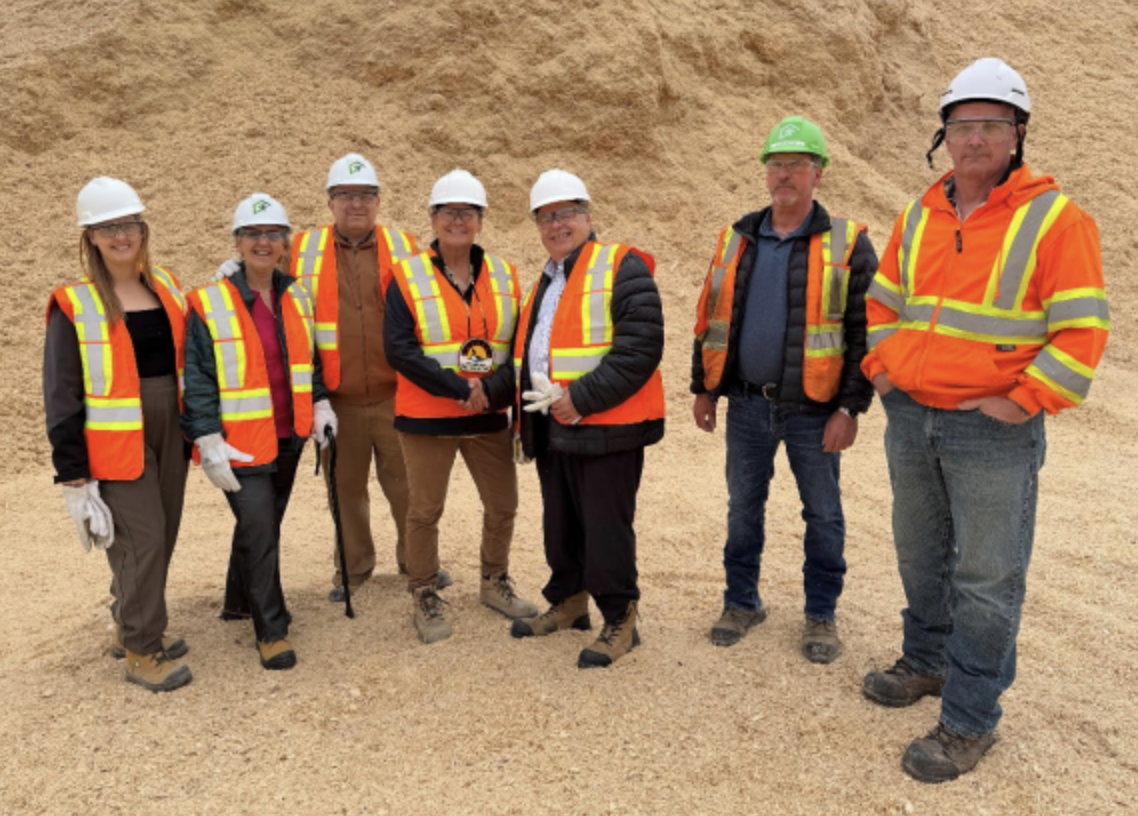
At the GreenFirst sawmill in Chapleau (L -R): Sophie Viel, Sylvie Sylvestre, Padraic Taaffe, Margaret Coulter, Robert Manseau, Eric Tremblay, and Ryan Bignucolo.
Chapleau Cree First Nation and Commercial Bioenergy Inc. have jointly created a dedicated bioheat company called Chapleau District Heating Company Inc. The newly established for-profit company aims to own and operate a 3-megawatt thermal district heating plant serving institutional-scale buildings within the community. As a regional first, this initiative will demonstrate the economic and social benefits of a community-scale circular economy powered by local biomass.
The company’s first project under the partnership is a biomass district heating system in the Township of Chapleau, demonstrating how locally available, sustainable wood resources can be transformed into reliable, community-scale heat while keeping energy expenditures within the local economy. The project seeks to convert public institutions from fossil fuel heating to a centralized biomass district heating system using wood residuals from the GreenFirst sawmill in Chapleau.
“This partnership is about looking at energy differently,” said Chief Keith Corston of Chapleau Cree First Nation. “For our Indigenous and Northern communities, energy is not simply a utility; it is an opportunity for economic development, resilience, and the long-term sustainability of our communities. By working together, we can develop solutions that are designed for the realities of our communities, our families, and create benefits that stay here.”
Chief Corston added, “We wanted the first project to be an example of the innovation and potential of biomass for our communities. What better way to show this than supporting buildings that impact everyone in our communities? This project will be the cornerstone for a path towards community resilience, economic growth, and sustainable development.”
Operating as a utility, the Company will sell its heat on a per-kilowatt-hour basis to participating institutions, saving them not only on heating operating costs but also on the increasingly high capital infrastructure costs associated with upgrading their current systems. “It’s a win-win on three levels,” said Robert Manseau, President of Commercial Bioenergy Inc. “First you save on heating costs, then you save on maintenance costs, and you extend the life of existing boilers thereby avoiding creeping capital costs.”
Instead of sending dollars out of the community to purchase fossil fuels, biomass heating can create opportunities to source fuel locally, supporting forestry and related industries, creating local employment and keeping economic benefits within the region.
“Biomass gives Northern communities an opportunity to turn a challenge into an economic asset,” said Mr. Manseau. “We are not simply replacing one heating system with another. We are looking at how communities can build a more resilient energy system around resources, businesses, and people that already exist in the North.”
A New Model for Northern Energy
The partnership will explore opportunities to deploy biomass heating within Chapleau Cree First Nation and the neighbouring Township of Chapleau. Projects may include district heating systems, energy efficiency initiatives, and other innovative approaches that reduce reliance on fossil fuels while strengthening local energy security.
“We are really looking forward to the local opportunities this company will create,” said Mayor Ryan Bignucolo of the Township of Chapleau. “With the first initiative being a first-of-its-kind district heating system in the yownship of Chapleau, I am honoured to have participated in this project and excited to see the benefits in our community. This project not only represents an opportunity for a greener community, but also for the long-term
economic benefits to stay right here, and for other communities like Chapleau to see the potential for biomass energy.”
The partners will also work to identify opportunities where Indigenous communities can
play a meaningful role in project development, ownership, operations, and the economic benefits generated by new energy infrastructure.
The goal is not simply to bring new technology to Northern communities, but to develop a Northern model for energy innovation, one that reflects local priorities and creates long-term community value.
“This is about the future of heating in the North,” said Mayor Bignucolo. “It’s taking a unique alignment of circumstances: the availability of residual wood due to the changes in the forestry sector, the advancement of the energy sector in northern Ontario, the increased desire to reduce fossil fuel dependency, and combining them with innovative technologies to resolve a common constraint for communities across Canada.”
“Part of the innovation is taking the resources, knowledge, relationships, and opportunities that already exist in our communities and bringing them together in a new way. That is what this partnership represents: a new approach to the commercialization and economic advancement of biomass in northern Ontario. This isn’t just a heating solution; it is community-based advancement.” Mayor Bignucolo added.
The first project will serve as an important demonstration of what can be achieved through collaboration between Indigenous communities, Indigenous businesses, and energy companies.
By combining Indigenous leadership and community knowledge with biomass expertise and innovative technology, the partners aim to establish a model that can be adapted and replicated in other rural and remote communities.
Gaétan Malette, MP Kapuskasing-Timmins-Mushkegowuk commented, “I would like to congratulate Chapleau Cree First Nation and Commercial Bioenergy Inc. on this innovative district heating project, which will use wood residues to provide sustainable energy to the town of Chapleau.”
Gaétan Malette, MP Kapuskasing-Timmins-Mushkegowuk added, “This project demonstrates the potential of utilizing sawmill residues into a valuable source of renewable energy for our communities. It represents an important step towards modernizing Northern Ontario’s forestry industry.”
Bill Rosenberg, MPP Algoma—Manitoulin commented: “This biomass project in Chapleau represents an exciting opportunity not only for the forestry and biomass sectors, but also for the community and Northern Ontario as a whole.”
Rosenberg continued, “The collaboration between Chapleau Cree First Nation and Commercial Bioenergy has the potential to deliver meaningful economic and social benefits, while reducing operating and maintenance costs for participating institutions and creating positive impacts for local communities and families.”
Rosenberg added, “This innovative partnership is an important step toward strengthening local sustainability, fostering entrepreneurship, and supporting long-term economic development throughout the region. I wish everyone involved great success in bringing this important initiative to fruition.”

- Indigenous Joint Venture Advances Community-Scale Bioheat Project in Chapleau - October 23, 2026
- eye care professionals warn of cosmetic contact lens risks ahead of Halloween - October 23, 2026
- Wawa Community Outreach Program to Suspend Services Due to Unrenewed Funding - October 20, 2026