 Wawa-news.com Local and Regional News
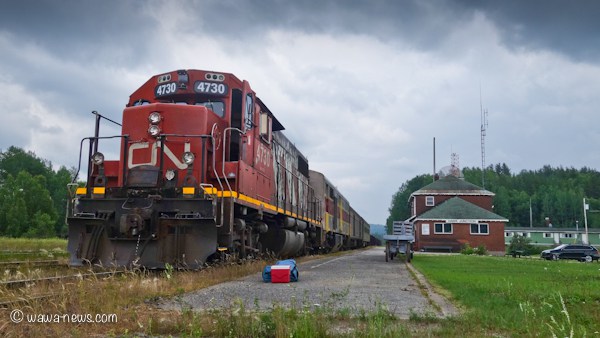
Last ACR Passenger Train to leave Hawk Junction on July 13, 2015.
To fund, or not to fund passenger rail in northern areas of Algoma District … That is the question some residents, property owners, municipalities and organizations want an answer to from the federal and the provincial government.
A petition filed earlier this year calls upon parliamentarians to reinstate the Algoma Central train (ACR) between Sault-Ste-Marie and Oba Lake. Service would be reintroduced to Hearst at a later date. Proponents of the project are asking both levels of government to each contribute 50% of the cost to restore the train; roughly two million dollars in start-up expenses, and seven million to operate annually.
The ACR, not to be confused with the Agawa Canyon Tour Train, once served isolated communities, lodges and settlements in Algoma District. It was discontinued in 2015, seemingly without public consultation, after Transport Canada, a federal institution responsible for transportation policies, made significant changes to the program that previously funded the service.
The ACR was rendered ineligible for what was a two million dollar operating subsidy; a decision the Stephen Harper government defended, citing the presence of highways at Sault-Ste-Marie, Hawk Junction and Hearst. The same cannot be said though for approximately 370 kilometres of track that doesn’t overlap with public roads or provincial highways. This restricts access to certain private residences, First Nation traditional territories, businesses, and logging and mining sites. Roads through Provincial Parks and Crown Game preserves might only operate whenever the parks are open.
What public roads that exist north of Sault-Ste-Marie aren’t necessarily open year-round, nor built and maintained to the same standards as those overseen by municipalities or the province. They may even be closed for extended periods of time or inaccessible whenever the Trans-Canada highway is shut down due to collisions or weather related incidents.
Critics will sometimes point to Ontario Northland’s motor coach as an alternative to the ACR. The bus makes a total of five stops between Sault-Ste-Marie and Wawa before continuing westward to Thunder Bay. Furthermore, I’m not entirely sure how passengers are supposed to load ATVs, snowmobiles, canoes, animal carcasses or furniture aboard a bus.
The poor child of passenger trains
Right until its demise, the ACR appeared to operate differently than other passenger trains. For starters, why was this rail service outsourced to a private company, rather than to an existing Crown corporation, like VIA Rail, or to a First Nation-owned railway?
VIA has a mandate to provide train service in several rural and remote regions “where alternative, year-round transportation is limited or unavailable”.
In 2015, the federal government gave the ACR a reprieve with three more years of funding. However, when Canadian National no longer wanted to run the ACR passenger train, many months were spent jumping through hoops in order to find a reputable operator.
Railmark Canada was selected in spring 2015. Months later, when it was reported the company was unable to secure a line of credit, the train was cancelled.
There’s also the issue of inconsistent ticket pricing. A passenger’s fare was not only calculated by distance travelled, but also dependent on which community they boarded at. Example of one-way ticket costs within one zone from 2015:
- $23.35 from Sault-Ste-Marie;
- $34.30 from Hawk Junction or Hearst;
- $41.00 from all other points (if purchased on board the train)
Equally as baffling was the decision in later years to relocate the Sault-Ste-Marie passenger depot; from the Station Mall to an industrial rail yard.
What’s next?
There is some debate whether taxpayers should subsidize transportation geared around tourists or to communities with year-round connections to conventional highways.
Yet, public dollars are used to maintain some 3,300 kilometres of roadways into Canada’s national parks, just as they subsidize VIA Rail’s long-distance and remote region trains.
They also allow pleasure craft operators to navigate the Rideau Canal or the Trent-Severn Waterway.
Seasonal ferry service between Tobermory and Manitoulin Island, two road-linked regions, is financially supported by the Government of Ontario with the stated purposed of “supporting tourism and regional connectivity”.
A lot has changed since the heyday of the ACR.
In the early 1990s, between 25,000 and 30,000 annual passenger trips were reported on this route. In 2013, 5,166 were logged.
The line between Franz and Oba, which is currently inactive, admittedly needs work. Track speeds along this railroad max out at 64 kilometres per hour.
I also have my doubts whether isolated Oba Lake is an appropriate terminus should this rail service be reintroduced.
Supporters of the ACR have their work cut out for them.
Through no fault of their own, passengers were left stranded a decade ago by governments who weren’t exactly forthcoming with their plans.
I’m not entirely sure what the path forward looks like.
But, I believe they deserve another chance to be heard and to present a valid case for remote Algoma District passenger rail, adapted to today’s transportation needs.
Éric Boutilier is a columnist for Northern Tracks, a self-published blog related to intercity transportation in Northern Ontario.

- Majority of Survey Respondents Call for Municipal Response to Nuclear Waste Transportation & Burial Plan - October 19, 2026
- Incident at Canadian Forces Base Wainwright – UPDATED - October 19, 2026
- Hornepayne Community Hospital – Outbreak Notice - October 16, 2026